Exercises: Inscribed and Circumscribed Circles
Warm-Up
The perpendicular bisector of a segment is the set of all points that are equidistant from the segment's two ̲ ̲ ̲ ̲ ̲ ̲ ̲ ̲ ̲ ̲ ̲ ̲ ̲ ̲ ̲ ̲ ̲ ̲ ̲ ̲ ̲ ̲ .
An angle bisector of an angle is the ray that divides the angle into two equal parts. A point on the angle bisector is equidistant from the two ̲ ̲ ̲ ̲ ̲ ̲ ̲ ̲ ̲ ̲ ̲ ̲ ̲ ̲ ̲ ̲ ̲ ̲ ̲ ̲ ̲ ̲ of the angle.
The inscribed circle (incircle) of a triangle is the circle that ̲ ̲ ̲ ̲ ̲ ̲ ̲ ̲ ̲ ̲ ̲ ̲ ̲ ̲ ̲ ̲ ̲ ̲ ̲ ̲ ̲ ̲ .
Fluency Practice
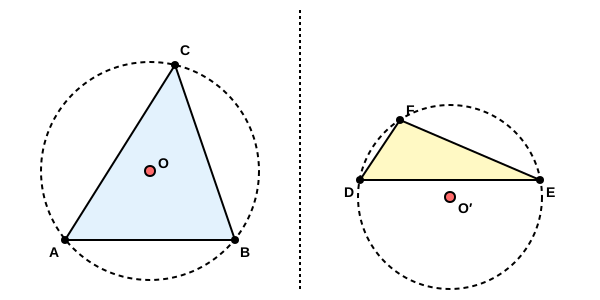
The circumcenter of an obtuse triangle lies ̲ ̲ ̲ ̲ ̲ ̲ ̲ ̲ ̲ ̲ ̲ ̲ ̲ ̲ ̲ ̲ ̲ ̲ ̲ ̲ ̲ ̲ .
Triangle is inscribed in a circle with center . If cm, what is the length ? Give your answer in centimeters.
To locate the incenter of triangle , you construct ̲ ̲ ̲ ̲ ̲ ̲ ̲ ̲ ̲ ̲ ̲ ̲ ̲ ̲ ̲ ̲ ̲ ̲ ̲ ̲ ̲ ̲ .
Triangle has an incircle with center . The inradius (the perpendicular distance from to side ) is 5 cm. What is the perpendicular distance from to side ? Give your answer in centimeters.
Cyclic quadrilateral is inscribed in a circle. If , what is ?
Varied Practice
Quadrilateral is inscribed in a circle. The angle measures are , , , and . Which statement correctly describes these angles?
To prove the three perpendicular bisectors of triangle are concurrent, we argue: Let be the intersection of the perpendicular bisectors of and . Since is on the perpendicular bisector of , we know . Since is on the perpendicular bisector of , we know . Therefore by ̲ ̲ ̲ ̲ ̲ ̲ ̲ ̲ ̲ ̲ ̲ ̲ ̲ ̲ ̲ ̲ ̲ ̲ ̲ ̲ ̲ ̲ , so also lies on the perpendicular bisector of .
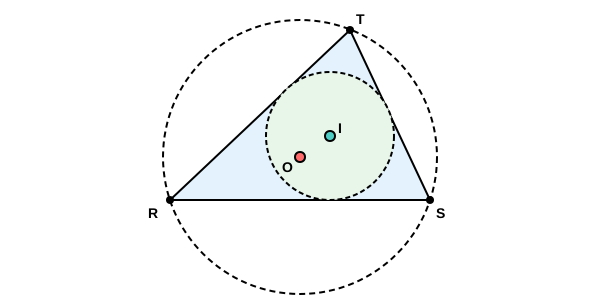
Triangle has an incircle with center and a circumscribed circle with center . Which statement is always true?
Explain in your own words why you only need to construct two angle bisectors to find the incenter of a triangle. Why is the third angle bisector guaranteed to pass through the same point?
Quadrilateral has , , , . Can quadrilateral be inscribed in a circle?
Word Problems
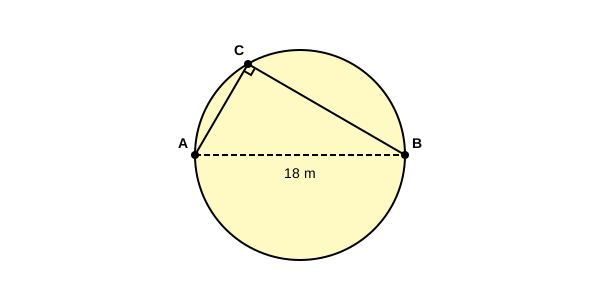
A landscape architect inscribes a triangular garden in a circular fountain basin. The triangle has a right angle at vertex , and the diameter of the fountain is 18 m.
What is the circumradius (the radius of the fountain) in meters?
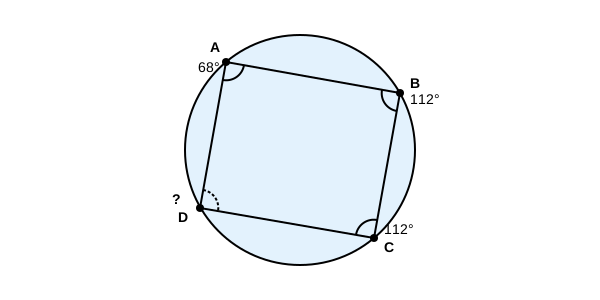
A decorative tile is in the shape of cyclic quadrilateral inscribed in a circular ring. The angles at vertices , , and are , , and , respectively.
Find in degrees.
Quadrilateral has angle measures , , , and .
Can quadrilateral be inscribed in a circle?
Explain which theorem you used to decide whether is cyclic, and state the theorem precisely.
Error Analysis
Mia says: "In cyclic quadrilateral , opposite angles are equal, so and . If , then ."
What is the error in Mia's reasoning?
Leo says: "The inscribed circle (incircle) of triangle passes through all three vertices , , and — just like the circumscribed circle. Both circles have the same center, the incenter."
Identify all errors in Leo's statement.
Challenge
Write a proof that the three perpendicular bisectors of the sides of triangle are concurrent (all meet at one point). Your proof should explain why two perpendicular bisectors are sufficient to find the circumcenter, and why the third is guaranteed to pass through the same point.
Write a proof that opposite angles of any cyclic quadrilateral are supplementary. Let be inscribed in a circle. Your proof should use the Inscribed Angle Theorem to show .